Contamination during the manufacturing and assembly of high-tech components is considered one of the greatest threats and appears in various forms. In a series of interviews, we gather our top technical specialists in assembly, parts manufacturing, and development to encourage collaboration and innovation. For this fourth interview, two of our specialists in different areas of cleanliness describe how they ensure the highest standards of cleanliness.
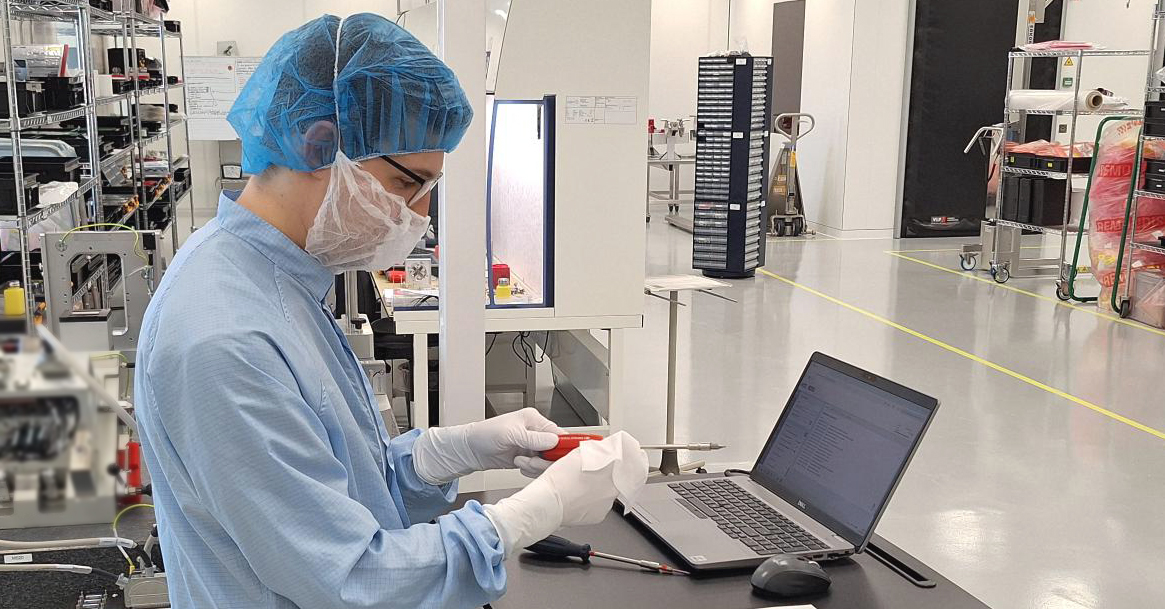
The first specialist is Martijn Schrier, All-Round Cleanroom Mechanic at Hittech Multin. In the picture, he is shown using an IPA wipe to clean his tools.
Martijn: ‘The parts we assemble are used in critical sections of high-tech semiconductor machines. In this environment, minuscule dust particles of 10 micrometres can pose a major threat. But even the grease on a glove from touching your face can out-gas, and with certain vapours, the effects might only become apparent after several months. Perhaps the greatest risk is a lapse in concentration because contamination can hide in the smallest places. I try to make people aware of this before they enter the cleanroom. A single fingerprint anywhere in the supply chain can cause immense damage!’
How do you manage to keep the team aware of these threats at all times?
Martijn Schrier: ‘For several years, I have been leading the cleanroom training on contamination hazards. I mainly focus on mindset training and raising awareness. Social monitoring is also vital, but in a positive and supportive manner. The company’s mantra is that if you’re unsure whether something is contaminated, just assume it is. Dust particles are only visible with a UVB lamp, not to the naked eye. Hairnets are required for beards 5 mm or longer, but we recommend wearing one even if your beard is shorter. Don’t take any risks; it’s better to be extremely safe than very sorry.’
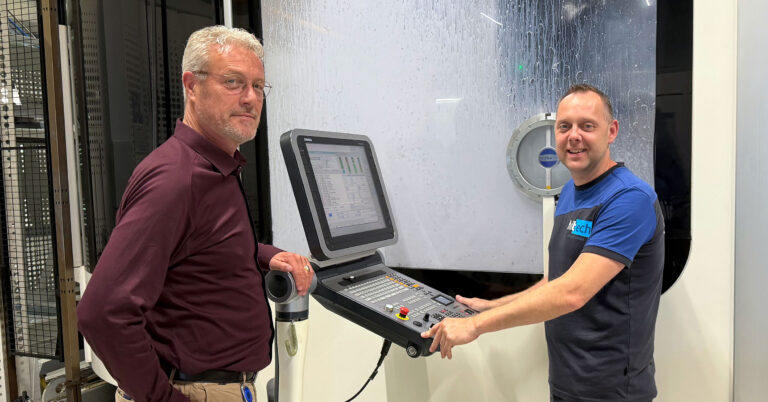
Koen Mentink, the Managing Director at Hittech Bihca, acknowledges the threats Martijn and his team are facing.
Koen Mentink: ‘The majority of our machining work, including milling, turning, EDM, grinding, and laser welding, takes place outside cleanrooms, where we face contamination risks beyond fine dust particles, specifically residue liquids and gases. We also collaborate with clients in the semiconductor sector, where cleanliness standards differ from those in the food sector, for example. The most common threats include silicones, carbon compounds, water-based substances, dust particles, and, in some cases, copper contamination on surfaces.’
Is the main focus on cleanliness at Hittech Bihca in the process of washing the parts?
Koen Mentink: ‘You might think so, but actually, we began researching the cleanliness of the milling process with TNO in 2008. Together with a team of their researchers, we mapped our manufacturing process to measure residual gases and, later, Total Organic Control. We developed a checklist that we still use for staff training. After 30 years in the business, I can tell you that the list of threats and focus points has expanded considerably, with tolerances becoming increasingly strict. But that’s what keeps us sharp.’