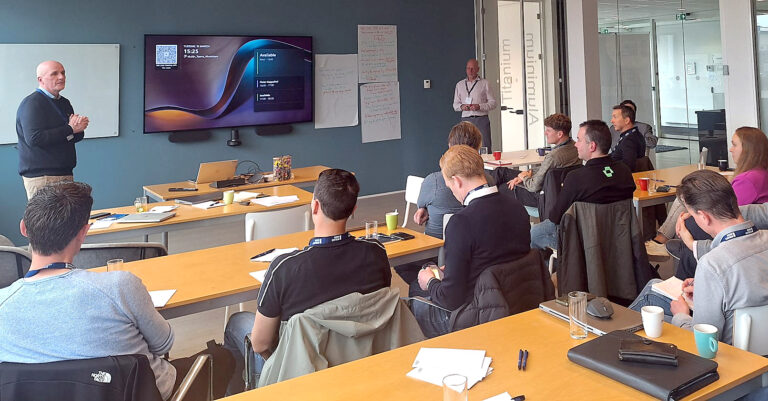
This is Roger Senden, ‘back’ at TU Delft, where the roots of Hittech RSP Technology lie, to discuss microstructures. “To be precise, I talked about conventional microstructures in aluminium versus our speciality: the Melt Spinning of nanostructured alloys,” says Roger.
Roger Senden is managing partner of Hittech RSP Technology, one of the four companies worldwide that operate the Melt Spinning technology to produce unique, high-performing materials.
Roger: “The Delft University of Technology developed the Melt Spinning technology in the late 70s, and that project evolved into the company called RSP Technology in 1993. The bond with the university has always been strong, and it’s important to maintain that connection. I noticed that a younger generation of material specialists is increasingly less familiar with Melt Spin technology, which is a pity because it will play a significant role in the near future!”
For which industry do you see a potential for aluminium superalloys?
Roger Senden: “These superalloys are designed to improve the aluminium’s characteristics such as strength, stiffness, expansion, density, workability, fatigue, and so on. The fine microstructure is highly suitable for optics because the surface is better, which means that laser communication mirrors perform better. And those high-end communication satellite constellations are a growing market. Those lasers must be aligned very precisely, which is a meticulous mechanical operation. We also supply materials for the control terminals used for this purpose. During my dialogue with the students, I try to explain that details in the microstructure can have a significant impact on the macro behaviour of materials.”
Special thanks to Associate Professor Vera Popovich from TU Delft.